Long before Christianity, Crete was a sacred land—the mythical birthplace of Zeus and center of the Minoan religious universe. The Christian faith took root here in the 1st century AD through Saint Titus, disciple of Apostle Paul and the island’s first bishop.
What followed was seventeen centuries of unbroken spiritual tradition: Byzantine churches built over ancient holy sites, remote wilderness monasteries, and a world-renowned icon-painting legacy that shaped El Greco. Today, Crete’s active monasteries and living religious calendar—from village Easter services to vibrant summer feast days—remain deeply felt traditions rather than historic relics.
The Great Monasteries
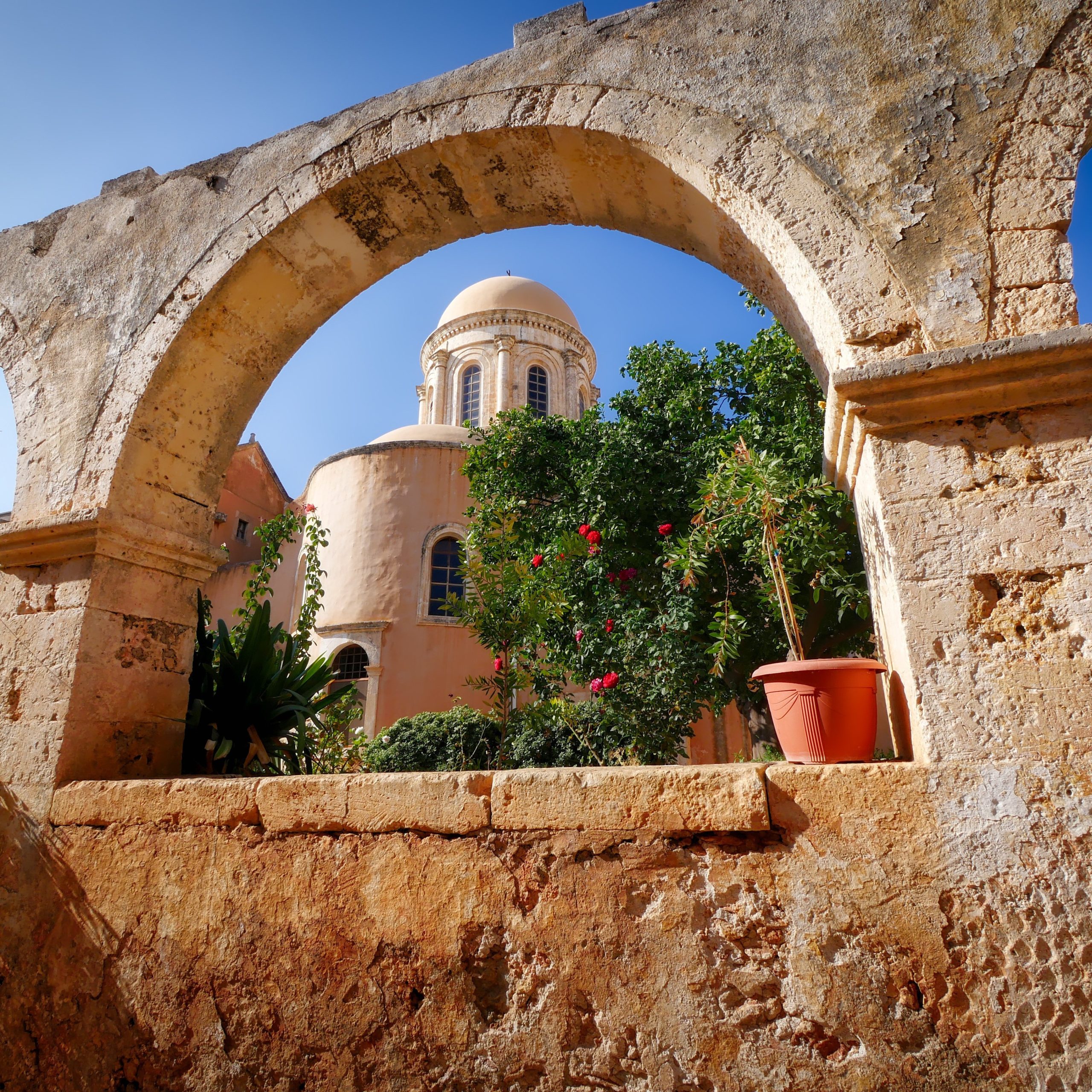
Monasteries such as Arkadi, Toplou, and Agia Triada, along with many lesser-known churches and sacred routes, offer a journey into the spiritual heart of Crete. Some are active religious centres, while others are historic landmarks closely tied to the island’s identity.
Crete's most famous monastery and, for many Cretans, the most sacred, renowned for its ornate 16th-century Venetian Baroque facade and its monumental role in Cretan history. During the 1866 Ottoman siege, its defenders chose death over surrender — an act of collective sacrifice that sent shockwaves through Europe and became an enduring symbol of faith and freedom. Arkadi is an active monastery and open to visitors year-round.
Moni Preveli
South Crete · Rethymno Prefecture
Perched on a dramatic cliff above the Libyan Sea, Preveli combines one of the most spectacular settings of any religious site in Greece with a history of resistance — to Ottoman rule and, in 1941, to the German occupation, when its monks sheltered and helped evacuate hundreds of Allied soldiers. The monastery's wonder-working fragment of the True Cross draws Orthodox pilgrims throughout the year, particularly on the feast of the Holy Cross (September 14).
Moni Toplou
Far East Crete · Siteia Prefecture
A 15th-century fortress-like monastery built to withstand pirate raids, housing one of the great masterpieces of Cretan iconography: Ioannis Kornaros' Lord Thou Art Great (1770) — a monumental icon composed of 61 individual scenes. The monastery also manages one of the largest organic agricultural estates in Crete, producing wine, olive oil and herbs of exceptional quality.
Moni Chrysoskalitissa
Far West Crete · Chania Prefecture
Dramatically situated on a rock above the Mediterranean at the southwestern tip of Crete, this 17th-century monastery is dedicated to the Dormition of the Virgin Mary. Its name — "Gold Step" — derives from the legend that one of its 90 stone steps is visible as solid gold only to the pure of heart. The principal Marian pilgrimage site in western Crete.
Churches & Sacred Art
The Cretan School of Icon Painting - Island-wide tradition
Between the 14th and 17th centuries, Crete was the Orthodox world's premier center for icon painting. Following the fall of Constantinople in 1453, Cretan masters preserved and exported the Byzantine artistic tradition across Europe—most famously producing Domenikos Theotokopoulos, later known as El Greco. Beyond the famous monuments, Crete’s interior holds dozens of quiet, 10th- to 15th-century frescoed chapels hidden among olive groves in areas like the Amari Valley, Spili, and Myrthios. Led by an art historian, exploring these lesser-known churches offers an extraordinarily intimate look at medieval sacred art away from the crowds.
Notable Churches
Cathedral of Saint Mina (Agios Minas)
· Heraklion
The seat of the Archbishop of Crete, Saint Mina is one of the largest cathedrals in Greece. Built in the late 19th century, it is dedicated to the patron saint and protector of Heraklion. The cathedral is renowned for its grand neo-Byzantine architecture, impressive twin bell towers, and majestic interior frescoes.
Church of Saint Titus (Agios Titos)
· Heraklion
One of the island's most historically layered churches, originally Byzantine, reworked under Venetian and Ottoman occupation, restored to Orthodox use in the 19th century. It houses the revered skull of Saint Titus — returned from Venice in 1966 after nearly four centuries — and remains the most important Christian site in the city. The feast of Saint Titus (August 25) draws pilgrims from across the island.
Panagia Kera
· Kritsa, Agios Nikolaos
A 13th-century triple-nave Byzantine church celebrated for housing the best-preserved and most magnificent collection of late Byzantine frescoes in Crete. Tucked away in an olive grove near Kritsa, this small church is a cornerstone of medieval Orthodox sacred art.
The Basilica of Saint Titus
Gortyna, Messara Plain · South-Central Crete
Gortyna was once the capital of Crete and the seat of Saint Titus, the Apostle Paul's disciple and the island’s first bishop. Its 6th-century Byzantine basilica, set among the Roman ruins of the Messara plain, remains one of Crete’s most important early Christian monument. No other site in Crete marks so precisely the moment the ancient world became the medieval one
Church of Agia Triada (Holy Trinity)
· Gortyna, Heraklion
Located within the vast archaeological region of ancient Gortyna, this 14th-century Byzantine church is a hidden gem of rural Crete. Built on the grounds of a historic Minoan estate and ancient Roman capital, the church features simple stone architecture and preserved medieval frescoes. It stands as a peaceful reflection of Crete’s early Christian heritage, surrounded by ancient olive groves and classical ruins.
Church of Saint Nicolas
· Splanzia, Chania
A fascinating testament to Crete's layered history, this 14th-century church originally served as a Dominican monastery, was converted into a mosque during Ottoman rule, and later restored as an Orthodox church. Remarkably, it features both a traditional Venetian bell tower and a tall Ottoman minaret side-by-side.
Church of Saint Mark
· Heraklion
Built by the Venetians in 1239 as the official ducal chapel, Saint Mark is one of the finest examples of Venetian Gothic architecture in Crete. Located opposite the Morosini Fountain in Heraklion's central square, it now functions as the Municipal Art Gallery while remaining a key architectural landmark
Panagia Kaliviani
· Moires, Messara
Originally a medieval monastic complex, Panagia Kaliviani was restored in the 19th century after the miraculous discovery of an ancient icon of the Annunciation. Today, it is an active convent renowned across Crete for its extensive charitable works, peaceful courtyards, and beautiful modern basilica.
Cathedral of the Presentation of the Virgin (Trimartyri)
· Chania
A 19th-century cathedral in the heart of Chania's Old Town, built on the site of an earlier Venetian church and known locally as "Three Martyrs." Features a striking bell tower, beautiful iconography and deep historical connections to Chania's struggle for independence.
Churches & Sacred Art
The Idaion Antron — Cave of Zeus
· Mount Ida (Psiloritis) · Central Crete
One of the most significant sacred sites in the ancient Greek world. According to mythology, the infant Zeus was hidden here by his mother Rhea; archaeological excavation has confirmed continuous ritual use from the Minoan period through the Roman era, with votive offerings from across the ancient Mediterranean. At 1,538 metres, reached by a path across the Nida plateau, the cave rewards the approach with altitude, silence and a quality of light that mountain sanctuaries seem to hold. It is not an easy visit — and that is precisely the point.
The Diktaion Antron — Cave of Zeus on Mount Dikti
· Lasithi Plateau · East Crete
The more accessible of the two sacred caves associated with the birth of Zeus, located above the Lasithi Plateau — one of the most beautiful highland landscapes in Crete. The cave was one of the most important cult centres of the ancient world, producing Minoan votive offerings of extraordinary richness now held in the Heraklion Archaeological Museum. The descent past enormous stalactite formations carries the weight of four thousand years of worship.
Living Orthodox Tradition
Easter in the Mountain Villages
· Island-wide · March or April or beginning of May
Easter is the most important event in the Greek Orthodox calendar, and in Crete it is celebrated with an intensity that has few equivalents anywhere in the Christian world. In the mountain villages — particularly in Sfakia, Anogia and the Lasithi plateau — but also in every village of Crete the Holy Week liturgies, the Epitaphios procession on Good Friday and the Resurrection service at midnight on Holy Saturday are communal acts of faith that have changed little in centuries. The combination of candlelight, incense, ancient chant and the eruption of fireworks at the moment of Resurrection is one of the most powerful ritual experiences available in Europe.
The Feast of the Assumption — August 15
·Island-wide · Peak Season
The Dormition of the Virgin (Dekapentavgoustos — the Fifteenth of August) is, after Easter, the most important feast in the Orthodox calendar. Monasteries and churches dedicated to the Virgin — Chrysoskalitissa, Preveli, dozens of village churches across the island — hold all-night vigils and solemn liturgies drawing hundreds of pilgrims.. For groups visiting in August, it is one of the most evocative encounters with living Orthodox tradition on the island.
Panigiri — The Saints' Day Festival
·Village-wide · Throughout the Year
Every village in Crete has its patron saint, and the saint's feast day — the panigiri — is the social and spiritual event of the village year. A liturgy in the morning, a communal meal in the afternoon, music and dancing in the evening: the panigiri is one of the last surviving forms of community celebration in Europe that is simultaneously religious and festive without contradiction. For groups visiting between May and October, the chance to attend a village panigiri is an encounter with Cretan culture that no archaeological site or museum can replicate.